Sauna Tradition and Bathing Practices
Part of the Finnish Life
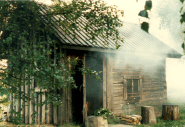
Through centuries the sauna has been a natural and integral part of the Finnish life.
Going to the sauna has always been as normal a thing as eating or sleeping. When settlers
inhabited the country the first building they built was a sauna. First it was also used
for dwelling until a house was built. This was also true for Finns settling in other
countries, e.g. Sweden and America: sauna would always be erected first. Likewise, Finnish
soldiers, including UN troops of today, have always built permanent or make-to-do saunas
whenever and wherever the situation has permitted.
Different Uses
Today the sauna is probably considered as much a place for cleaning the body as for
relaxing the muscles and refreshing the mind. Originally the cleaning function has been
secondary, if there at all, and the purpose of the sauna has been well feeling and
recovery from the day´s toil. However, the sauna was not only used for bathing, but it
served many other functions in the agricultural society of the past.
Because of the frequent heating and the coat of soot (charcoal) all over, the sauna was
by far the most hygienic place in a household. It was therefore natural that the sauna was
used for health related functions, such as curing illnesses, healing wounds, delivering
babies, even preparing bodies of the dead. Herbs and charms were used for the sick, and an
old but still well known saying states that if spirits (vodka), tar and sauna do not help,
the sickness is fatal.
Saunas were also used for many farming chores, such as curing meat, preparing malt and
drying flax for linen.
Sacred Place
For most Finns the sauna is not only a place to relax and get cleaned, but it has also
a character of certain sacredness. The first and most cited rule on behavior in the sauna
says that one should behave in the sauna as in church. Loud talking should be avoided, and
quarreling or cursing definitely do not belong to the sauna. Finns also find reading
papers or arrangements to watch television or listen to radio completely out of place in
the sauna. A sauna is rather a place to quiet down and let the soothing warmth take one´s
thoughts into paths of meditation!
The sacred character of the sauna comes from the past. It was believed that saunas were
dwelling places of different spirits. In the Finnish tradition these sauna spirits were
mostly of good character, but nevertheless they were not to be disturbed by improper
behavior.
Morals
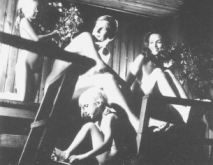
By a general rule in Finland today men and women do not go to the sauna together unless they are friends or members of the same family. Public swimming pools with sauna departments have separate saunas for ladies and men but the steam rooms (a kind of sauna) is for both men and women.
Of course there are exceptions to this, e.g. mixed groups of (mostly young) people may
spontaneously go to a common sauna, but even in these cases the sauna going is rarely
connected to any kind of sexual behavior. It is also unthinkable in Finland that the sauna
name would be used as a disguise for sex clubs, as unfortunately is the case in many
places elsewhere.
In the past, partly even until the Second World War, the above "rule of the
family" has had a much wider interpretation. In the country it was not uncommon that
servants would go to the sauna together with the people of the house, provided the sauna
was large enough. In public saunas in towns there often was no separation of the sexes at
all: families would come and bathe together with their neighbors and complete strangers,
too. However, people learned the proper sauna conduct from early childhood, and no
breaches of decent behavior are known to have taken place. Nakedness in the sauna has
always been considered natural and not in any way associated with sex.
How Often?
The frequency of going to the sauna seems not to have changed in the course of time:
Finns bathe in the sauna about once a week. Traditionally the day to go to the sauna has
been Saturday, after the week´s work has been done. The sauna has softened the muscles
and cleaned the body before the day of rest. In the summer and during periods of heavy
work, such as harvesting, the sauna would be heated every evening. This is true even
today. The exceptional time today is the summer vacation, which many Finns spend on their
summer cottage. There they may heat their sauna as often as they wish. Practices vary from
every day to once a week.
How Long?
There are no set rules as to how long one should stay in the löyly or how many
times warming up and cooling off should be repeated: everyone should do exactly as feels
good. The time to stay in the heat naturally depends on the temperature, humidity and the
individual. Likewise, some people are happy with one or two rounds of warming and cooling
while others like to go on for hours. Practices vary even on the individual level
depending on one´s state of mind: some days the sauna just "tastes" better than
on others.
Cooling Off
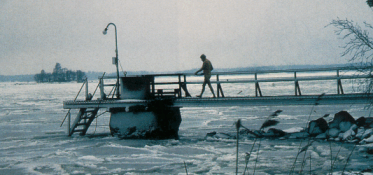
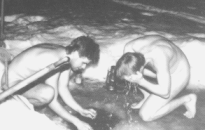
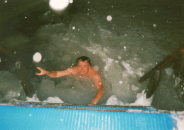
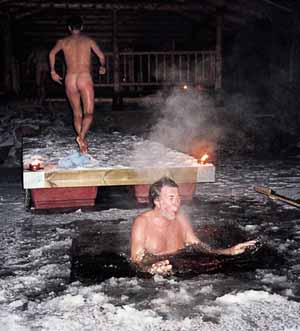
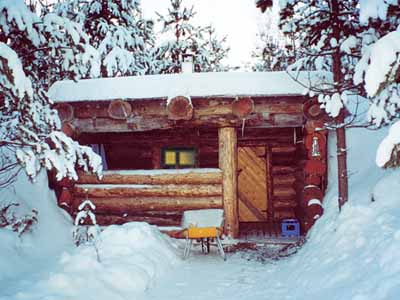
The most popular way to cool off between and after being in the hot room is to swim in
a lake or sea, if possible. Many Finns like to do this all year round, which means cutting
a hole in the ice in winter. The time to stay in the water is as individual as staying in
the hot room: whatever feels comfortable is the best. Speaking of the icecold water this
can be anything from a quick dip to a few strokes back and forth (space allowing). The
same goes for rolling in the snow. When the skin temperature is dropped by the cold water
or snow the heat escapes from the body slower than otherwise, allowing one to sit longer
outside even in cold weather without feeling cold.
A very rapid change from the hot into the icecold can be too strenuous even to a
healthy person and is not recommended, it is better to let the pulse settle for a while
before a dip in the water or snow. People with heart problems should stay away from this
kind of cooling off completely.
Sauna Temperature
In the old smoke saunas the temperature varied from about 50 to 75°C (122 to 167°F).
The lower the temperature the more water was generally used and the more humid was the
resulting heat. A higher temperature with less humidity was considered better. By today´s
standards these temperatures seem rather low. The recommendation now is 80-90°C
(176-194°F) with moderate humidity, but in many saunas today the temperature exceeds
100°C (212°F), at least at the beginning. When a traditional wood burning sauna is
heated for many people, the temperature must be high at first or otherwise the last
bathers would not have enough heat left.
The Whisk
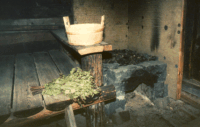
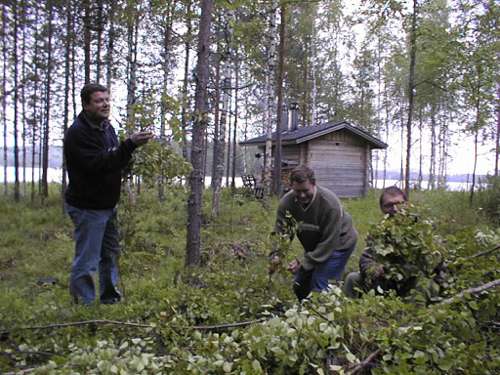
The birch whisk (vihta or vasta) used to be an integral part of sauna
bathing. When the skin softens in the sauna, beating it with the whisk stimulates blood
circulation and gives a pleasant sensation comparable to scrubbing or massaging. The smell
of the whisk adds to the feeling. In the past, when no soap was available, the chemicals
in the birch leaves acted as a cleaning substance. Using the whisk is more enjoyable when
the skin is thoroughly softened and the body has been adapted to the sauna. Therefore, the
whisk is usually taken into use only after the first round of warming and cooling off.
The whisk is at its best in the summer when it can be made of fresh birch leaves. This
also gives a nice smell to the sauna. Whisks for winter use are made in the summer (in
Finland late June and early July is the best time), and dried in the air (in dark to
preserve the green color!) or frozen. When taken into use dried whisks are softened in
warm water, whereas frozen ones are melted in cold water. Frozen whisks also preserve the
fresh smell.
Whisks do not have to be made of birch only, other trees may do as well, even conifers
can be used. In fact, softened juniper branches have been found to be excellent whisks!
Today the use of the whisk has rapidly declined. In urban areas where trees are not at everybody´s disposal whisks cannot be made, and many people have simply learned to do without them. Neither do they want to see the trouble of making a whisk in summer when heating their own cottage sauna.